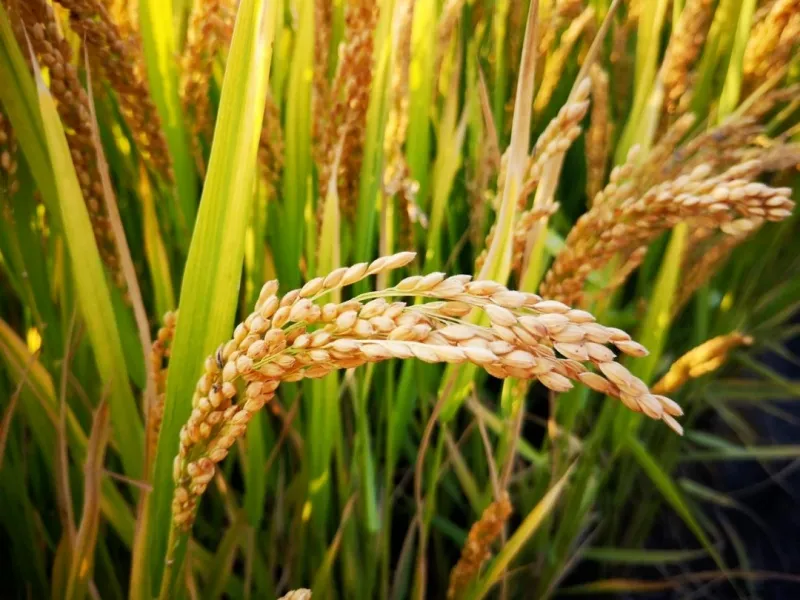
Rice husk is a by-product of rice milling. For a long time, it has been underused. It is usually treated as waste.
Open-air stockpiling takes up land. Natural degradation is slow. Direct burning pollutes the air. In most rice-growing regions, the husk has never been more than a disposal burden.
That is now changing. Advances in materials science have brought fresh attention to its value. Rice husk contains a significant share of silicon. It is one of the few renewable silicon resources found in nature. From precipitated silica for the rubber industry to high-purity quartz sand for photovoltaics and semiconductors, rice husk is being transformed. It is moving from “agricultural waste” to “strategic raw material.”
One class of equipment has long been overlooked on this path. That is grinding and ultrafine milling equipment. Grinding quietly sets the economic ceiling of this industry chain. It governs the reactivity of silicon extraction. It also governs the particle size and purity of the final product.
I. Rice-Husk-Based Precipitated Silica: A Route Already Proven at Scale
1. Why rice husk?
Rice is grown worldwide. A typical rice husk contains 17%–20% silica. After the husk is burned for energy, the residue is an ash rich in silica. Its silica content generally reaches 90%–95.5%. This makes it an ideal feedstock for precipitated silica, also known as white carbon black.
What matters even more is the form in which the silicon exists. Rice husk ash (RHA) is produced by low-temperature combustion. Apart from SiO₂, it contains only small amounts of metal salts and oxides such as K and Na. The silicon is present mainly in an amorphous structure. Amorphous silica is far more reactive than crystalline quartz. It can be dissolved in alkaline solution under mild conditions. No energy-intensive crushing or high-temperature melting is required. This is the fundamental advantage of RHA over mineral silicon sources. It is also why RHA is called the highest-silicon, most reactive of all agricultural residues.
2. Process route
The production of rice-husk-based precipitated silica uses rice husk as the main raw material:
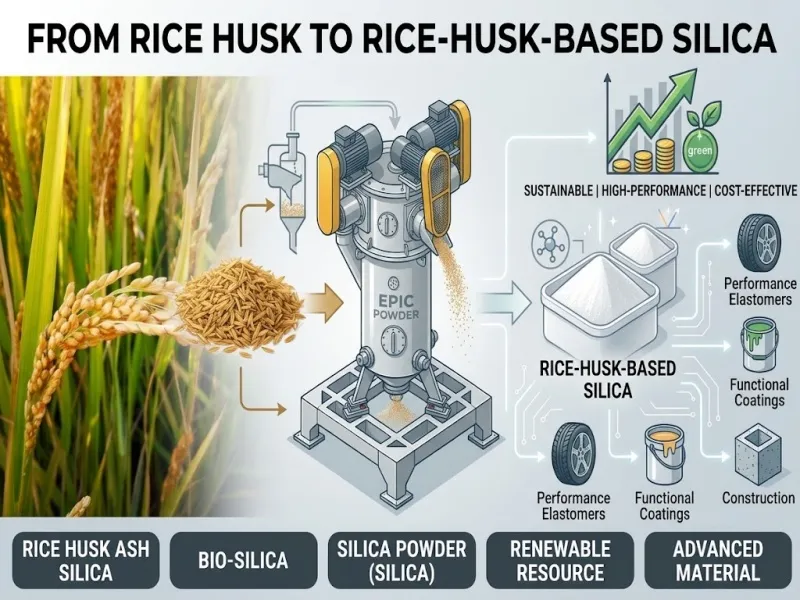
Rice husk → staged combustion / gasification in a boiler (energy recovery) → rice husk ash → screening → grinding and activation → alkaline dissolution (sodium silicate) → filtration → acid precipitation / carbonation → filtration and washing → drying → deagglomeration and classification → precipitated silica product
Side stream: filter cake residue → activation → activated carbon
The elegance of this route lies in its completeness. Nothing is wasted. The calorific value of the husk is first converted into steam or power. Silica is then extracted from the ash. The remaining carbon is turned into activated carbon. Both energy and material are recovered.
3. Product performance
The SiO₂ extracted from rice husk ash disperses well. Its aggregates break down readily into nanoscale primary particles. A small amount of organic residue remains on the surface. This improves the compatibility between the silica and the rubber matrix.
Rice-husk-based silica has been tested in natural rubber. It was compared against mainstream highly dispersible silica. The results are clear. It disperses better in natural rubber. The vulcanizate shows higher tensile strength. Overall performance is significantly better than that of the highly dispersible silica in common use today. Used in tires, it lowers rolling resistance and energy consumption. At the same time, it retains good low-temperature wet-skid resistance. It is also an excellent reinforcing agent for styrene-butadiene rubber. The reinforcing effect is markedly improved.
II. High-Purity Quartz Sand from Rice Husk: From “Rubber Filler” to “Chip Material”
1. Why alternative resources are necessary
High-purity quartz sand is a basic raw material for photovoltaics, optical fiber, and chip manufacturing. Today it is extracted mainly from high-quality quartz ore. Such ore is a scarce mineral resource. It is concentrated in a handful of countries: the United States, Norway, Australia, Russia, and India. This geographic monopoly translates directly into supply chain risk. It affects China’s strategic emerging industries, including PV, optical fiber, and chips.
In April 2025, China officially designated high-purity quartz as a new mineral type. The move was an institutional response to this anxiety. Exploration is only the first step, however. Finding non-mineral alternative silicon resources is the more durable solution.
Husk is a renewable silicon resource. Bio-based silicon derived from husk is becoming a new trend in the silicon materials industry.
2. The two routes and their opposite logic
One common misunderstanding should be clarified. The husk route and the ore route follow two opposite technical logics.
| Dimension | Ore route (top-down) | Husk route (bottom-up) |
| Starting point | Natural quartz ore (crystalline SiO₂) | Amorphous SiO₂ in rice husk ash |
| Core action | Crushing, grinding, scrubbing, magnetic separation, flotation, acid leaching, chlorination — strip the impurities out | Alkaline dissolution, precipitation or complexation purification, calcination — reassemble the silicon |
| Main impurity forms | Mineral inclusions, lattice substitution, gas–liquid inclusions | K, Na, Ca, Mg, Fe, plus residual carbon |
| Product form | Granular sand (crucible grade is mostly 70–350 μm) | High-purity ultrafine powder; needs further densification / vitrification |
| Role of grinding | Liberation, scrubbing, particle shaping | Reaction activation, particle-size window control, deagglomeration |
This distinction matters. The husk route first yields a high-purity ultrafine silica powder. It can go directly into markets such as silica micropowder, electronic packaging fillers, optics, and fine chemicals. For applications such as PV quartz crucibles, which require “granular sand with low gas inclusion,” additional steps are needed. These include densification, vitrification, and particle shaping. This is not a flaw in the route. It is a difference in product positioning.
3. Economics
Estimates show that one ton of husk can yield 150–180 kg of high-purity quartz sand with this technology. At the current average market price of about RMB 200,000 per ton for “5N” grade high-purity quartz sand, one ton of husk can generate more than RMB 20,000 in added value.
For comparison, husk sold as fuel or rough fodder fetches only a few hundred yuan per ton. The difference in magnitude explains why this route deserves investment.
III. Grinding Equipment: The Overlooked “Value Amplifier” in This Industry Chain

Discussions about high-value husk utilization tend to focus on combustion furnaces, reactors, and acid-leaching tanks. Grinding is rarely mentioned. From an engineering standpoint, however, grinding is the key variable that determines yield, energy consumption, and product consistency.
1. Four critical stations
(1) Pre-treatment crushing of raw husk
Rice husk is bulky and has very low bulk density. Fed directly into a furnace, it causes unstable combustion or gasification and low burn-out. Moderate crushing and shaping help. The husk can be crushed to a suitable size or pressed into pellets. This significantly improves combustion and gasification efficiency. It also stabilizes ash quality and gives downstream steps a consistent feedstock.
(2) Ultrafine grinding and activation of rice husk ash
This is the “value amplifier” of the entire line. Alkaline dissolution is a solid–liquid reaction. Its rate correlates directly with the specific surface area of the solid. After ultrafine grinding, the ash behaves differently:
- Specific surface area and surface defects increase. The SiO₂ dissolution rate rises.
- Lower reaction temperatures and shorter reaction times become possible. Alternatively, alkali concentration and alkali consumption can be reduced.
- The intergrowth between unburned carbon and the silica phase is opened up. This helps downstream carbon removal, which bears directly on product whiteness and purity.
Insufficient grinding holds the yield down. Excessive grinding drives energy consumption sharply upward. It also causes fine particles to pass through filters downstream and be lost. Finer is therefore not always better. Fineness must be matched to the downstream process.
(3) Deagglomeration and precision classification after drying
The primary particles of precipitated silica are nanoscale. Hard agglomerates form during drying, however. Rubber applications are sensitive to three things: agglomerate size, the width of the particle size distribution, and surface hydroxyl density. If deagglomeration is inadequate, the agglomerates become defect points in the rubber matrix. They degrade reinforcement and dispersibility.
This step therefore needs a specific combination. It requires deagglomeration equipment with low shear but sufficient impact, plus a high-precision classifier. It is not simply “grinding it again.” Over-grinding destroys the porous structure and the specific surface area. Reinforcement performance then falls. This is a trap many production lines fall into.
(4) Particle-size window control on the high-purity quartz sand route
In the purification stage, particle size control determines two outcomes. Too coarse, and encapsulated impurities cannot escape. Purity stays low. Too fine, and the large specific surface area raises acid and complexing agent consumption. Washing becomes difficult, and fine particles are lost. In practice, a different “particle-size window” must be set for each purification stage. Grinding should not simply continue to the finest possible point.
2. Four real difficulties in grinding rice husk ash
| Difficulty | Manifestation | Equipment response |
| Light, fluffy, poor flowability | Bulk density is typically only 0.15–0.30 t/m³. That is about 1/5 to 1/10 of ordinary quartz sand. The material bridges easily and is hard to feed steadily. | Forced feeding devices, air-lock feeders, and arch-breaking design in the silo |
| Dust explosion and occupational health risks | Fine silica dust is explosive. If combustion temperature runs out of control, crystalline cristobalite forms. The respiratory hazard of crystalline silica dust then rises sharply. | Fully sealed negative-pressure system, explosion-proof motors and venting devices, high-efficiency cartridge filters, online dust concentration monitoring |
| Zero tolerance for iron contamination | Both precipitated silica and high-purity quartz sand are extremely sensitive to metal ions such as Fe, Cr, and Ni. Iron introduced by wear lowers the product grade directly. It can even cause color to fail specification. | Iron-free design: media-free jet milling, ceramic / corundum / silicon carbide linings, zirconia grinding media, and integrated high-gradient magnetic separation at discharge |
| Agglomeration and broad size distribution | Ultrafine powder re-agglomerates easily. A broad distribution causes batch-to-batch variation. | High-efficiency classifier, variable-frequency classifier rotor, and closed-loop online laser particle-size measurement |
One coupling point is often overlooked. The combustion temperature must be kept in the range where SiO₂ stays amorphous. For low-temperature combustion or gasification, this is typically around 600–700 °C. If the temperature is too high, crystalline cristobalite forms. The alkaline reactivity of the silica then drops sharply, and grinding energy consumption soars. Crystalline silica dust also creates an occupational health risk. In short, the phase determined by combustion temperature directly determines how difficult and how costly downstream grinding will be. One degree of extra control at the front end saves a great deal of effort at the back end.
3. Equipment selection reference
| Stage | Typical fineness target | Recommended machine | Key configuration |
| Raw husk crushing | Coarse crushing to millimeter size / pelletizing | Hammer mill, ring-die pelletizer | Explosion protection, dust collection, iron removal |
| Medium-fine grinding of RHA | 80–400 mesh | Raymond mill / European-style mill, vertical roller mill | Dedicated forced-feeding design, variable-frequency classifier, negative-pressure dust collection |
| Ultrafine activation of RHA | D97 = 5–25 μm | Fluidized-bed jet mill, vertical stirred mill (wet) | Media-free or ceramic lining, zero iron contamination, narrow-distribution classification |
| Drying and deagglomeration of silica | Agglomerate breakdown | Flash dryer + disagglomerator + classifier | Controllable low temperature; avoid over-grinding |
| Particle shaping of high-purity silica powder | Size fraction set by stage | Jet mill / classifier combination | Online particle-size measurement, batch consistency control |
| Line-wide auxiliaries | — | Magnetic separators, dust collectors, DCS | Full-process control of metal ions |
One caveat is needed. The grinding behavior of rice husk ash differs from that of any conventional mineral. Before selecting equipment, run bench-scale or pilot milling trials on the actual ash sample. Base the final decision on particle-size-versus-energy curves and iron contamination test data. Do not simply transfer existing experience from mineral grinding.
4. Energy consumption and digitalization
Grinding is usually one of the largest power consumers in this type of production line. It directly affects the cost competitiveness of each ton of product. Several directions deserve attention:
- System-level energy saving. Equipment based on the bed-grinding principle, such as vertical roller mills, generally saves significant energy compared with conventional ball mill systems at the same fineness. Waste heat is already abundant from the combustion or gasification section. Using it for drying further reduces overall energy consumption.
- Closed-loop process control. Online particle-size measurement can be linked to classifier rotor speed. This converts “sample, test in the lab, then adjust the machine” into real-time control. Batch consistency improves markedly.
- Digital twin and maintenance. Wear monitoring and predictive maintenance on key components prevent unplanned downtime. On a continuous production line, the cost of one shutdown far exceeds the cost of spare parts.
IV. Conclusion:
As production and application technology for rice-husk-based silica matures, its use in the rubber industry will keep expanding. Green tires are the largest application market today. If rice-husk-based high-purity quartz sand continues to break through on purity stability and cost, its market space will far exceed that of rubber. After all, the PV, optical fiber, and chip sectors have never lacked demand. What they lack is supply that is autonomous and controllable.
A single husk was once smoke burning at the edge of a paddy field. Today it is becoming a reinforcing agent in green tires, high-purity sand in PV crucibles, and a link in the chip industry chain. From precipitated silica to high-purity quartz sand, the story of “turning husk into gold” has only just begun. What makes that story land is a complete set of modern powder equipment. Equipment that calculates particle size, purity, and energy consumption with precision.

“Thanks for reading. I hope my article helps. Please leave a comment down below. You may also contact Zelda online customer representative for any further inquiries.”
— Posted by Emily Chen