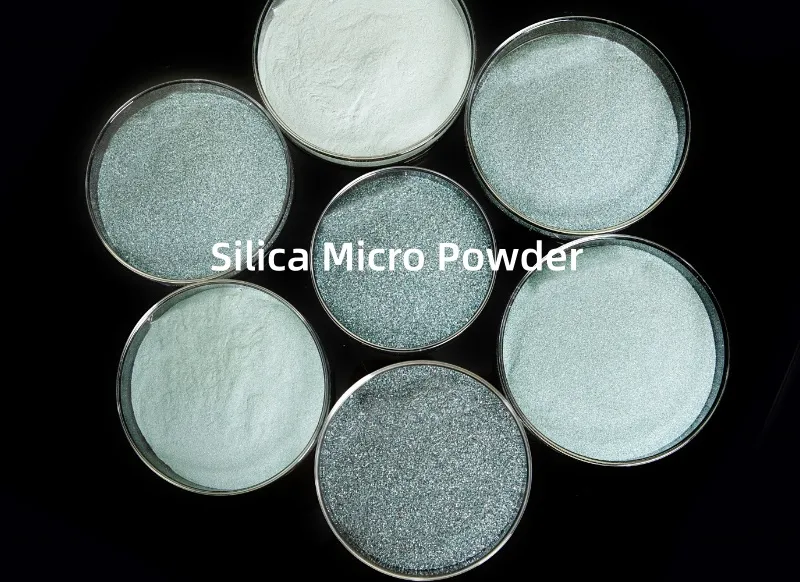
The same “silica powder” that performs reliably in coatings and refractories can cause serious trouble in high-end electronic applications such as copper clad laminates (CCL), IC packaging, and epoxy molding compounds (EMC). Typical symptoms include high system viscosity, rapid powder settlement, poor flowability, and impurity levels exceeding specification.
In most cases, the root cause is not a downstream formulation problem. It lies in the fundamental differences between powder manufacturing processes. Both alumina-lined ball milling and jet milling can produce micron-scale silica powder. However, the two processes differ dramatically in particle morphology, particle size distribution, impurity pathways, batch consistency, and application ceiling. Spherical silica powder goes one step further and breaks through the performance limits of both.
This article explains the complete selection logic for the three types of silica powder across five dimensions: process mechanism, core performance, cost structure, application selection, and purity risk.
1. Underlying Process Mechanism: Two Comminution Modes That Determine Powder Properties
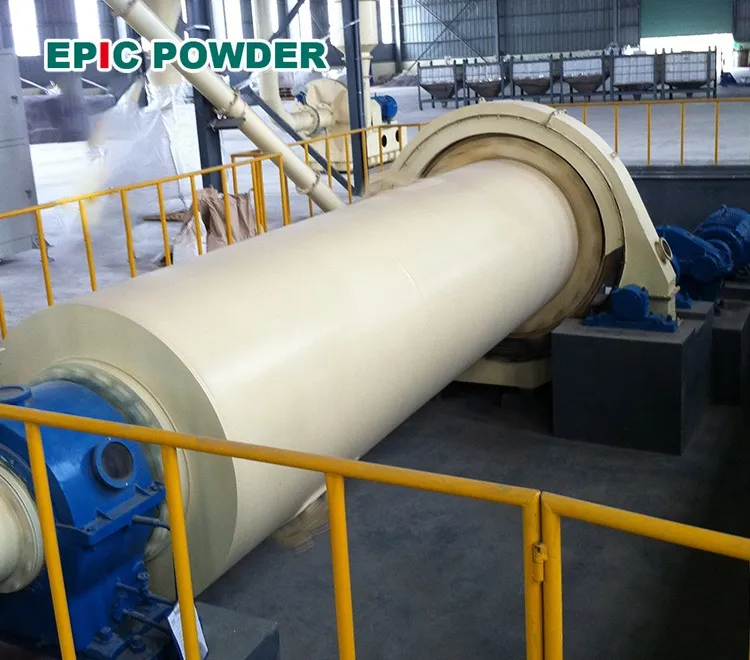
1.1 Alumina-Lined Ball Milling: Forced Comminution by Grinding Media
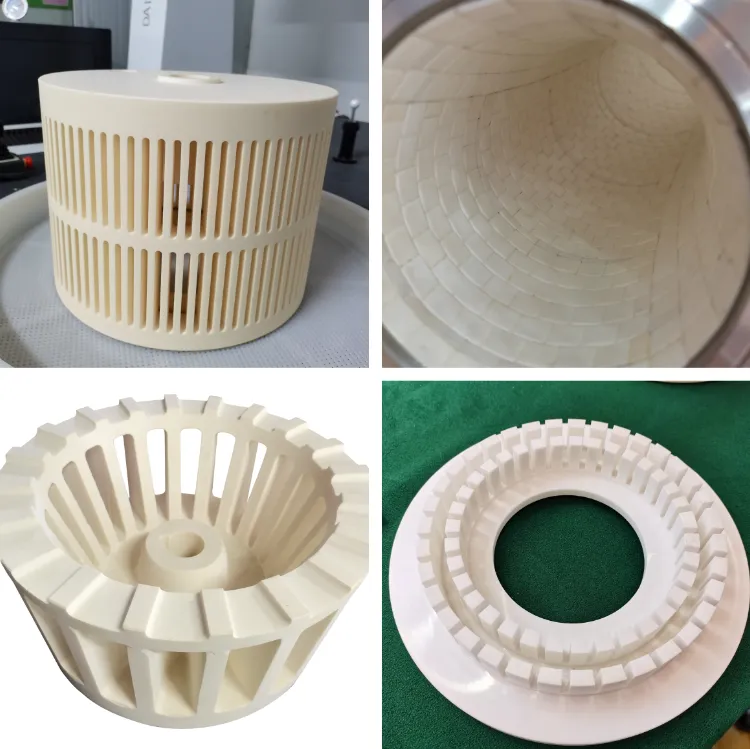
The core principle of ball milling is mechanical impact plus frictional shear. Alumina grinding balls move at high speed inside the mill drum, repeatedly impacting, crushing, and shearing the quartz feedstock.
Key strengths: The process is mature, equipment investment is low, and production capacity is large. High throughput substantially reduces the cost per ton.
Inherent weaknesses: The comminution method is “brute force.” The resulting particles are mostly irregular and angular. Particle size control depends on classification and grinding time, so ultrafine grinding capability is limited, the particle size distribution is broad, and batch-to-batch consistency is only moderate. In addition, media contact causes wear throughout the process. Even with an alumina-lined drum and alumina balls, trace alumina impurities are continuously introduced, so extreme purity cannot be achieved.
1.2 Jet Milling: Particle-on-Particle Self-Impact Comminution
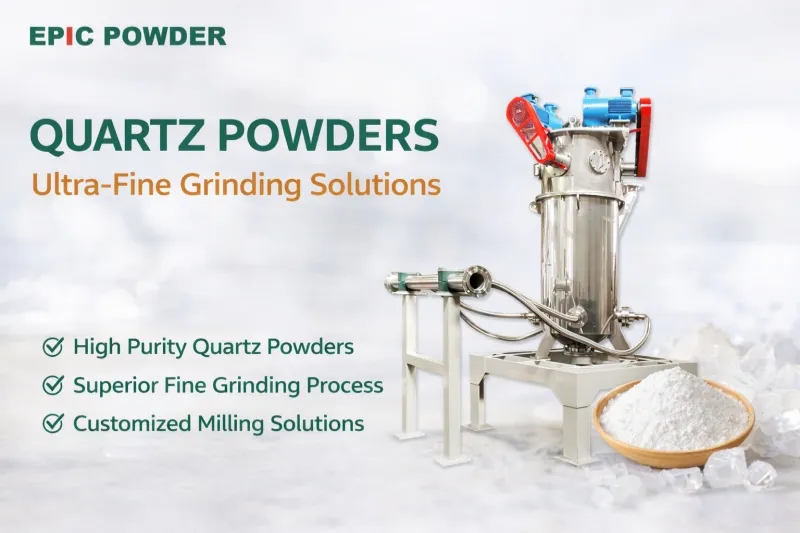
The core principle of the jet mill is particle-on-particle self-comminution. High-speed, high-pressure gas accelerates the quartz particles so that they collide with each other and fracture on impact. There is almost no contact with mechanical media throughout the process.
Key strengths: Jet milling can reliably produce ultrafine powder in the 1–5 μm range, with a concentrated particle size distribution and excellent batch-to-batch consistency. Particle edges are rounded and surfaces are smooth. The impurity introduction path is extremely short, so purity is far more controllable than in ball-milled silica powder. Powder flowability and dispersibility are greatly improved.
Key weaknesses: Gas consumption, power consumption, and maintenance costs are high. Equipment capacity is limited, so ultra-large-volume production is not feasible. A reasonable performance premium is therefore attached to the product.
One-sentence summary: Ball milling is “smashing rock with external force” — the powder is rough, uneven, and carries impurity risks. Jet milling is “rock shattering itself at high speed” — the powder is fine, uniform, pure, and smooth.
2. Core Performance Comparison: Four Dimensions That Define the Application Gap
The downstream compatibility of silica powder is determined by four key indicators: particle size distribution, particle morphology, purity and impurities, and flow and packing performance. These are the dividing line between low-end and high-end applications.
2.1 Particle Size and Distribution: Broad vs. Narrow
Ball-milled silica powder: Typical particle sizes range from a few microns to several tens of microns. Ultrafine grinding is difficult and inefficient. The particle size distribution is broad, with coarse and fine particles mixed together, and batch variation is obvious. Downstream users must frequently adjust formulations to compensate.
Jet-milled silica powder: The D50 can be precisely and stably controlled within 1–5 μm. The particle size distribution is extremely narrow, and powder performance is uniform and stable. The downstream process window is fixed, so no frequent parameter tuning is needed — ideal for precision manufacturing.
2.2 Particle Morphology: Angular and Rough vs. Rounded and Smooth
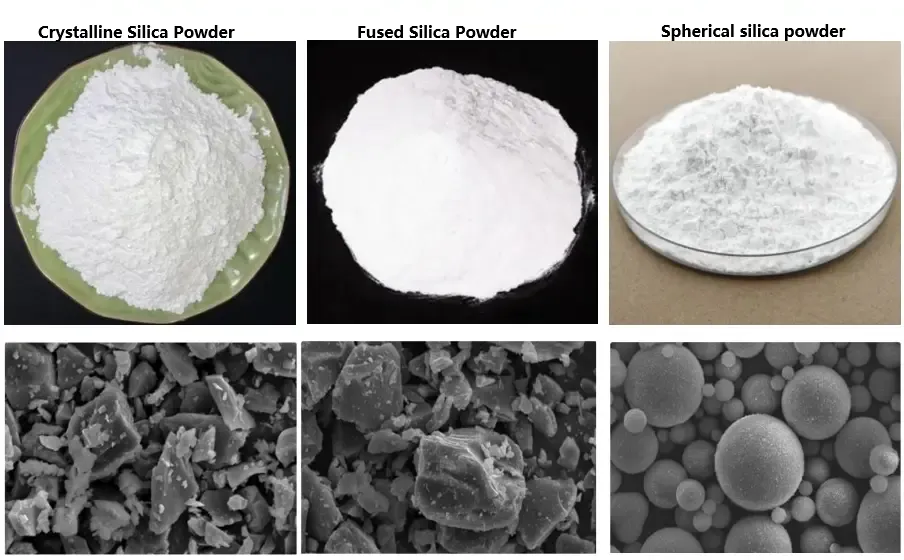
Ball-milled powder: Particles are mostly irregular and angular, with rough surfaces, resembling crushed glass shards. Once mixed into a resin system, the particles tend to interlock mechanically, which sharply increases system viscosity and results in poor flowability and difficult dispersion.
Jet-milled powder: Particle edges are rounded, without sharp corners, and surfaces are smooth. This reduces particle interlocking and friction, giving the resin system better flowability and easier dispersion.
2.3 Purity and Impurities: Poor Controllability vs. High Purity
Ball milling involves media wear throughout the process and continuously introduces trace alumina impurities, so there is a ceiling on achievable purity. This has little effect on coatings or refractories. In high-end electronic materials, however, impurities directly cause electrical performance fluctuation, increased dielectric loss, and reduced product reliability — a core hidden risk in customer qualification.
Jet milling involves no contact with mechanical media, so the impurity introduction path is minimal. It can stably deliver high-purity, low-impurity powder with extremely strong batch-to-batch purity consistency, meeting the stringent requirements of electronic materials.
2.4 Flowability and Packing: Inefficient Filling vs. High-Filler Loading
The packing capability of a powder is determined by particle morphology and uniformity. Angular ball-milled powder packs with large voids, agglomerates easily, and allows only low filler loading while raising system viscosity. Rounded, uniform jet-milled particles pack far more efficiently, enabling higher inorganic filler loading while maintaining low viscosity, easy degassing, and easy molding.
3. Cost and Pricing Logic: Low Price with Volume vs. High Price with Value
3.1 Ball-Milled Silica Powder: A Cost-Advantage Product
Low equipment investment, mature technology, massive capacity, controllable energy consumption, and simple maintenance allow mass production to dilute the cost per ton. The product competes on cost-effectiveness and suits price-sensitive, general-purpose applications with relaxed performance requirements.
3.2 Jet-Milled Silica Powder: A Performance-Premium Product
Energy, gas, and operating costs are higher, and capacity is limited. But the core value is not “finer particles” — it is greater stability, higher purity, and easier processing.
In high-end electronics, raw powder accounts for only a small share of the formulation cost. The real high costs are rework, line stoppages, and failed customer qualification caused by batch variation, abnormal viscosity, and excessive impurities. The premium on jet-milled silica powder is, in essence, payment for production stability and product reliability.
4. Application Selection: Matching the Scenario Matters More Than Chasing the High End
4.1 Ball-Milled Silica Powder: Cost-Oriented, General-Purpose Applications
Suited to fields where particle size, purity, and flowability requirements are not extreme and where stable supply and low price take priority: general industrial coatings, putty fillers, ceramic raw materials, refractories, and low-end general electronic fillers.
4.2 Jet-Milled Silica Powder: Performance-Oriented, Mid-to-High-End Applications
Suited to precision electronics fields with stringent requirements on powder stability, purity, flowability, and low viscosity: copper clad laminates (CCL), epoxy molding compounds, IC packaging materials, and high-end electronic potting adhesives.
5. The Next Step Up: The High-End Value of Spherical Silica Powder
Jet milling is an excellent solution for conventional ultrafine silica powder, but it is not the end point of performance. In top-tier scenarios that demand ultra-high filler loading, ultra-low viscosity, and ultra-high reliability, spherical silica powder offers irreplaceable advantages and represents the industry’s upgrade direction:
- Higher filler loading: Perfectly spherical particles pack densely with minimal voids, greatly increasing the inorganic filler ratio in resin systems and improving heat resistance, insulation, and mechanical properties.
- Lower system viscosity: Spherical particles replace sliding interlock with rolling friction, minimizing system viscosity and resolving the conflict between high filler loading and high flowability.
- Wider process window: Excellent flowability, dispersibility, and degassing performance suit precision potting, molding, and forming processes, delivering higher yield and more stable batches.
Industry performance upgrade path: ball-milled silica powder (cost-effective, general purpose) → jet-milled silica powder (ultrafine, high purity, stable) → spherical silica powder (high loading, low viscosity, high-end precision).
6. The Hidden Impact of Purity: The Baseline for High-End Materials
In general-purpose applications, purity is a nice-to-have. In electronic packaging and copper clad laminates, it is a hard baseline. Trace metal and alumina residues from the ball milling process may look negligible on a datasheet, yet they trigger a chain of hidden problems: dielectric parameter fluctuation, long-term humidity-heat aging failure, poor thermal-cycling stability, and inconsistent performance between batches — directly leading to failed customer qualification and batch scrapping.
In short, the high purity of a high-end powder is not a marketing gimmick. It is the core foundation for avoiding quality risks and ensuring long-term reliability.
7. Final Selection Summary
- General-purpose, cost-controlled applications — coatings, refractories, ordinary ceramics: Choose alumina-lined ball-milled silica powder for its high cost-effectiveness and stable supply.
- Mid-range electronics — copper clad laminates, ordinary molding compounds, stable low-impurity requirements: Choose jet-milled silica powder for uniform particle size, good flowability, and stable batches.
- High-end precision packaging — ultra-high filler loading, ultra-low viscosity, high reliability: Choose spherical silica powder to meet the demands of top-tier precision electronic processes.
8.FAQ: Silica Powder Selection
FAQ 1. What is the main difference between ball-milled and jet-milled silica powder?
The difference lies in the comminution mechanism. Ball milling uses alumina grinding media to impact and shear the quartz, producing irregular, angular particles with a broad particle size distribution, and the media wear continuously introduces trace Al₂O₃. Jet milling accelerates particles with high-pressure gas so they fracture by colliding with each other — no media contact — yielding rounded, smooth particles with a narrow, concentrated distribution (D50 1–5 μm) and far higher purity.
FAQ 2. Which silica powder should I use for copper clad laminates (CCL) or IC packaging?
For CCL, epoxy molding compound (EMC) and general electronic potting, jet-milled silica powder is the standard choice: its narrow particle size distribution keeps resin viscosity stable, and its high purity avoids dielectric loss and reliability issues. For top-tier applications demanding ultra-high filler loading (85 wt%+), ultra-low viscosity and the highest reliability — such as advanced IC packaging and 5G substrates — spherical silica powder is required. Ball-milled powder is suitable only for cost-driven, general-purpose uses such as coatings, refractories and ceramics.
FAQ 3. Why is spherical silica powder so much more expensive?
Spherical powder requires an additional spheroidization step (typically flame fusion) after ultrafine grinding, which consumes large amounts of energy and fuel and reduces yield. The premium is not for “smaller particles” but for engineering value: near-perfect spheres pack with minimal voids, enabling filler loadings above 85 wt% at viscosities that angular powder cannot reach, which directly translates into higher yield and reliability in precision packaging. In high-end electronics, the cost of a failed batch far exceeds the powder premium.
FAQ 4. Can I get jet-mill quality just by grinding ball-milled powder longer or finer?
No. Longer ball milling reduces particle size but cannot fix the two structural weaknesses: the particles remain angular and rough, so viscosity and dispersion problems persist; and media wear keeps introducing Al₂O₃ no matter how fine the powder becomes. The particle size distribution also stays broad. If the application requires narrow distribution, rounded morphology or high purity, jet milling (or spheroidization) is the only route.
FAQ 5:What does D50 mean, and why does it matter for my formulation?
D50 is the median particle size — half of the particles are smaller and half are larger. It is the most quoted specification because it drives packing density, resin viscosity and curing behavior. But D50 alone is not enough: two powders with the same D50 can behave very differently if their D97 and D100 differ. Always request the full laser-diffraction curve, not just the D50 value.
FAQ 6. What purity level does electronic-grade silica powder need?
As a rule of thumb, electronic grades start at SiO₂ ≥ 99.5% with Fe₂O₃ ≤ 30 ppm, Al₂O₃ ≤ 200 ppm and ionic Na⁺ and Cl⁻ each ≤ 20 ppm. Packaging-grade material for IC molding compounds goes further: SiO₂ ≥ 99.9%, Fe₂O₃ ≤ 10 ppm, and low-alpha specifications with U and Th each ≤ 0.1 ppb. The limit is not set by the datasheet alone but by the failure mode it prevents — dielectric loss, leakage, and long-term humidity-heat aging.

“Thanks for reading. I hope my article helps. Please leave a comment down below. You may also contact Molly online customer representative for any further inquiries.”
— Posted by Emily Chen