Anyone involved in sourcing or producing quartz powder knows this painful truth: choose the wrong mesh size, and the whole project fails. Too coarse, and you end up with rough castings or bubbles in synthetic stone slabs; too fine, and you deal with clogged production lines and doubled costs.
But what actually is “mesh size”? Where are 325 mesh, 800 mesh, and 2000 mesh used in practice? This guide breaks down mesh size ranges, particle sizes, and their real-world applications in one place.
First Steps: Understanding Mesh Size
“Mesh” refers to the number of openings in a wire screen per linear inch (1×1 inch area). For example, 200 mesh means the material passes through a screen with 200 openings per inch.
Golden Rule: The higher the mesh number, the finer the particle; the lower the mesh number, the coarser the particle.
Industry Classification Rule of Thumb
- ≤ 120 Mesh: Generally referred to as “Quartz Sand.”
- > 120 Mesh: Strictly called “Quartz Powder” (also known as Silica Powder / Micro-silica).
Key Quartz Properties
- Main Component: SiO2
- Mohs Hardness: 7
- Density: 2.65 g/cm3
- Melting Point: 1650–1750°C
- Characteristics: Acid and alkali resistant, electrically insulating, low thermal expansion coefficient.
- Purity Grades:
- Ordinary (90–99%)
- Refined (99–99.5%)
- High-Purity (99.5–99.9%)
- Ultra-High Purity (≥ 99.99%)
Mesh-to-Particle Size Quick Reference Table
| Mesh Size | Particle Size (μm) | Common Industry Application |
| 20–60 Mesh | 0.25-0.85mm | Coarse sand |
| 60–120 Mesh | 0.125-0.25mm | Medium sand |
| 200–325 Mesh | 45-125 µm | Fine sand |
| 600–800 Mesh | 18-45 µm | Micro powder |
| 1250–2000 Mesh | 6.5-10 µm | Ultrafine powder |
| 3000 Mesh+ | ≤5 µm | Electronic grade/Near nano grade |
Note: Common commercial grades mostly cluster around 325, 600, 800, 1250, and 2000 mesh. 3000 mesh and nano-scale powders can be custom-produced.
Application Breakdown by Mesh Range
1. 20–120 Mesh (Coarse to Medium Sand Segment)
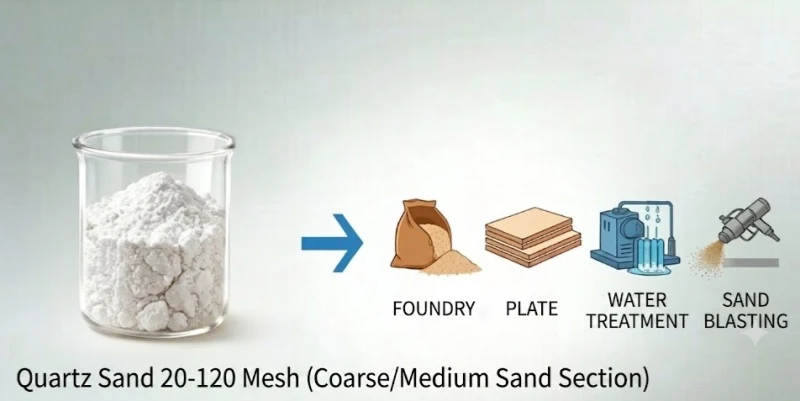
Primary uses: Casting, synthetic stone slabs, water treatment, sandblasting.
While technically classified as “sand,” this segment shares the same supply chain upstream and is frequently sourced alongside quartz powder.
- Large Castings (20–60 Mesh): Offers high permeability and good collapsible properties.
- Precision Casting / Lost Foam (60–120 Mesh): Delivers a smooth casting surface.
- Artificial Quartz Slabs: Uses 80–120 mesh as the primary sand aggregate, combined with 40–60 mesh coarse sand and 150–200 mesh fine powder to balance strength, density, and finish.
- Water Treatment Filtration: Uses 20–80 mesh. 20–40 mesh serves as the lower support layer, 40–80 mesh handles fine filtration, and pure water systems use 80–120 mesh.
- Sandblasting / Artificial Turf: Uses 10–40 mesh.
2. 200–400 Mesh (Entry-Level Fine Powder Segment)
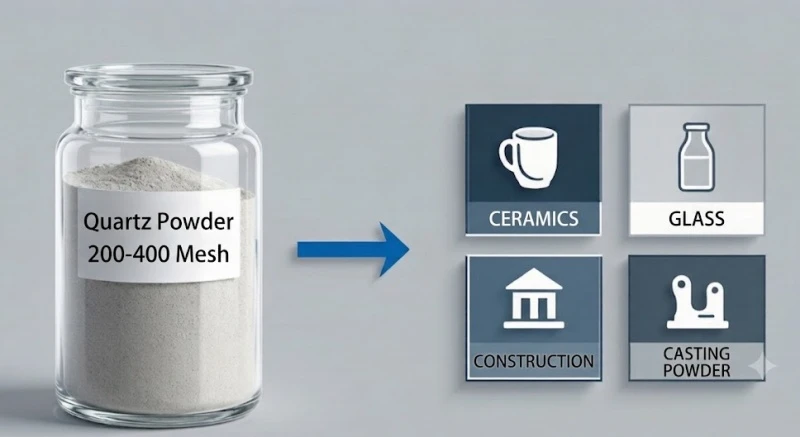
Primary uses: Ceramics, glass, construction, casting powders.
Crossing the 120-mesh threshold brings you into true quartz powder territory.
- Ceramics & Refractory Materials: Commonly uses 325 mesh refined powder (heat resistant to 1600°C+) for green bodies, glazes, and refractory bricks.
- Float Glass, Glass Bottles, & Fiberglass: Uses high-purity powder (SiO2 ≥ 99.5%, Fe2O3 ≤ 0.02%) as a primary raw material.
- Building Infrastructure: 100–200 mesh mixed with standard sand for high-strength concrete, permeable pavements, and floor aggregates.
- Precision Casting (Powder Level): 200–325 mesh is used for molding sand and abrasive blasting, preventing pinholes in finished castings.
3. 325–800 Mesh (Mainstream Micro-Powder Segment)
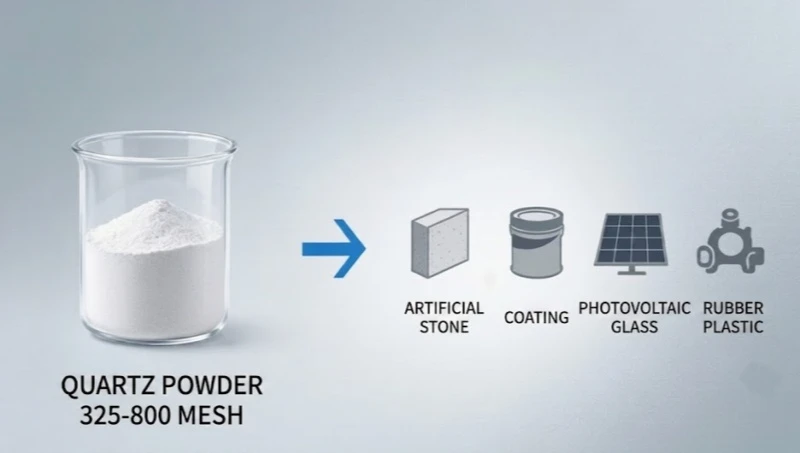
Primary uses: Artificial stone, coatings, photovoltaic glass, rubber, and plastics.
This is the highest-volume segment, where the price gap between “sand” and “powder” widens significantly.
- Artificial Quartz Slabs / Marble: Uses 325–800 mesh ultra-white powder (Whiteness ≥ 95 to prevent color bleeding, scratch marks, and warping.
- Photovoltaic (PV) Glass: Uses 325–800 mesh micro-powder requiring SiO₂≥99.8%.
- Silicon Wafer Cutting / Polishing: Uses 800 mesh, with strict purity requirements.
- Paints & Inks: Uses 600 mesh to improve film hardness, weather resistance, and powdering resistance. Widely used in exterior wall coatings and anti-corrosion paints.
- Rubber & Plastic Fillers: Boosts wear resistance, acts as a reinforcing agent, and lowers production costs.
4. 1250–3000 Mesh (Ultra-Fine / Electronic-Grade Segment)
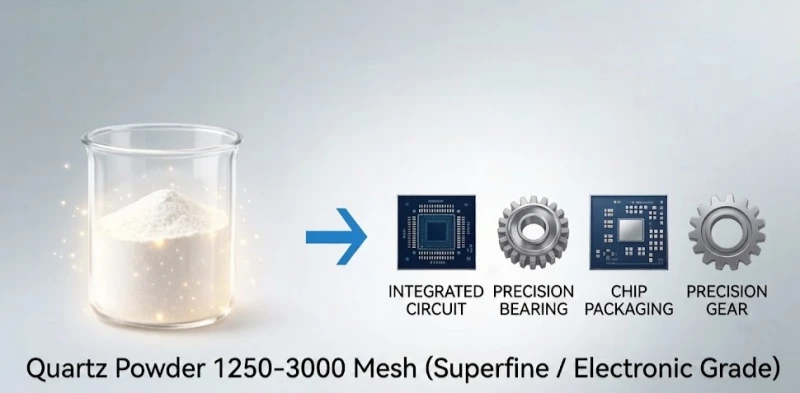
Primary uses: Semiconductors, IC packaging, high-end ceramics.
At this level of fineness, purity matters even more than mesh size.
- Electronic Packaging & High-Frequency Copper-Clad Laminates (CCL): Around 3000 mesh with SiO₂≥99.99%; acts as a core functional filler in semiconductor packaging.
- Semiconductor Components: 1200–2000 mesh used for quartz crucibles, quartz boats, and chip encapsulation materials.
- Optical Fiber & Advanced Ceramics: Requires ultra-high purity specialty grades.
- Laboratory High-Temperature Glassware: Used to manufacture quartz crucibles and tubing capable of withstanding 1700°C+.
- Aerospace Components: Custom ultra-high purity grades for high-temperature insulation and piezoelectric components.
⚠️ Common Pitfall: Meeting the mesh requirement without controlling iron content (Fe₂O3) will still lead to rejection by semiconductor fabs. Electronic-grade specs evaluate a three-part metric: Mesh Size + Purity + Trace Alkali Ions (Na/K).
Key Procurement Takeaways
- Particle Size Distribution (PSD) is more critical than a single mesh number. A uniform particle distribution ensures smooth flow, prevents clogging or clumping, and simplifies sintering or mixing.
- Blending particle sizes (e.g., combining 40 + 80 + 150 mesh in slab recipes) achieves tighter packing density and prevents cracking or sagging better than using a single size.
- Quartz powder is not automatically better when finer, nor is it cheaper when coarser.
- Coarse ranges focus on permeability and strength.
- Medium ranges focus on whiteness and loss on ignition (LOI).
- Ultra-fine ranges focus on purity and trace ions.
Always follow this selection sequence: Determine the application first → select the mesh range → specify the required purity grade.

“Thanks for reading. I hope my article helps. Please leave a comment down below. You may also contact Zelda online customer representative for any further inquiries.”
— Posted by Emily Chen