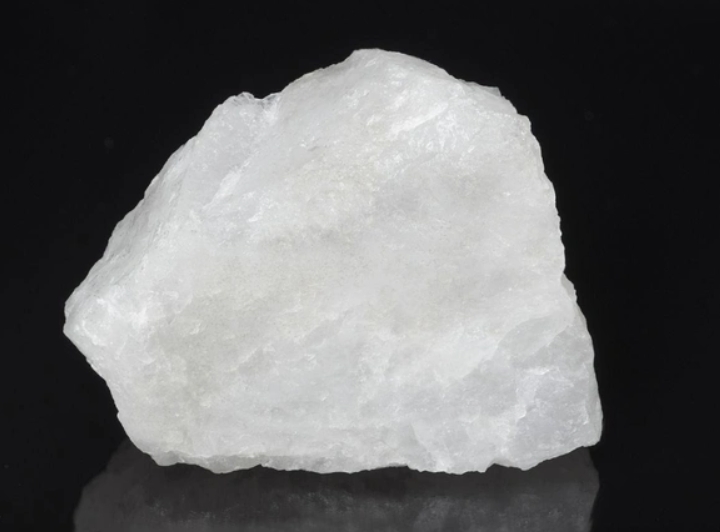
Quartz stone slabs are primarily produced by mixing quartz powder, silica flour, and resin binders, followed by pressing and curing. Quartz powder serves as the core backbone filler in these slabs.
Untreated raw quartz powder has strong surface polarity and high hydrophilicity. As a result, it shows poor compatibility with the specialized organic resins used in slab manufacturing.
Using untreated powder leads to several critical issues:
- Poor powder dispersion and agglomeration.
- Weak interfacial bonding between the powder and the resin.
- Micro-voids and low bonding strength inside the finished slab.
- Higher risk of color bleeding, poor stain resistance, brittleness, and cracking.
Ultimately, these defects shorten the lifespan and lower the quality of the engineered quartz slabs.
After mechanical crushing, silanol and siloxane groups form on the quartz powder surface along with adsorbed micro-water. This surface state provides strong reaction activity. It allows silane coupling agents to bond firmly to the powder, establishing the essential foundation for effective quartz powder modification.
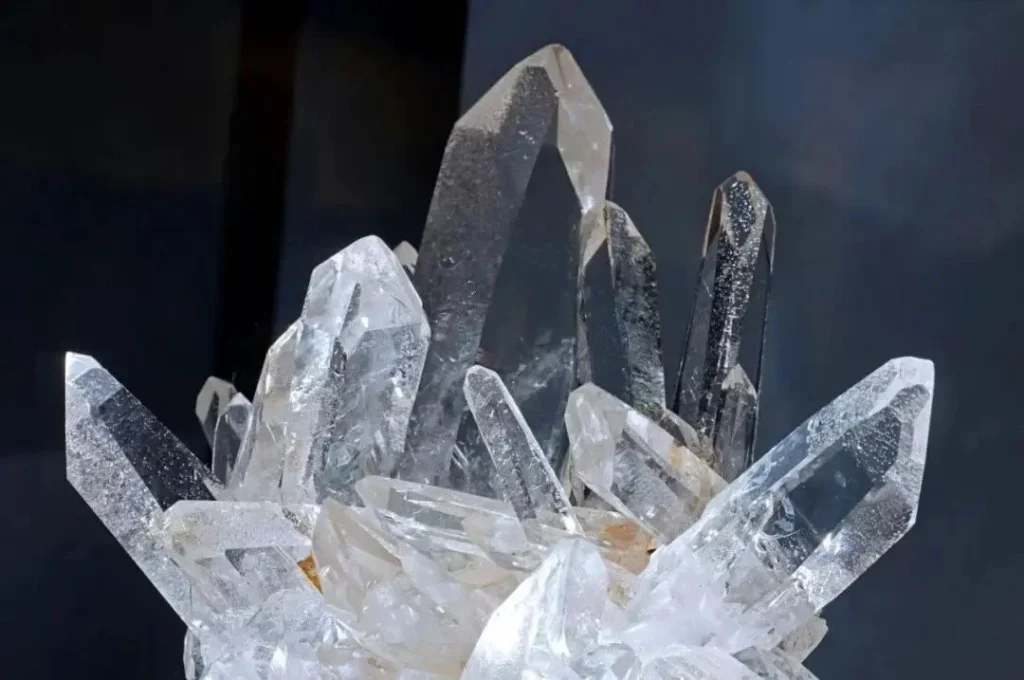
Core Principles of Quartz Powder Modification
For resin-bonded quartz stone systems, the industry widely adopts silane coupling agent surface modification. Epoxy-functional, methacryloxy-functional, and vinyl-functional silane coupling agents are commonly selected to match specific slab resin systems and molding processes.
The core mechanism of quartz powder modification relies on chemical bonding to achieve complete compatibility between inorganic quartz powder and organic resin. The process consists of three key steps:
- Hydrolysis: The alkoxy groups of the silane coupling agent hydrolyze with moisture adsorbed on the powder surface, forming reactive silanol groups.
- Dehydration Condensation: These active groups undergo condensation with surface groups on the quartz powder. This forms stable siloxane bonds that firmly coat the particles and eliminate hydrophilic surface groups.
- Organic Coating: The exposed organic functional groups of the coupling agent interact with the resin. This forms a uniform, active organic layer on the powder surface.
Modified quartz powder features significantly lower surface energy, higher wettability, and improved dispersion in resin. This solves resin-powder incompatibility at its root. It enhances slurry fluidity during processing, strengthens the interfacial bond, and delivers dense, high-strength, stain-resistant, and age-resistant quartz slabs.
Key Factors and Equipment Matching in Modification
To meet the standards of high-end quartz stone production, five key parameters must be controlled: coupling agent selection, dosage, reaction temperature, retention time, and system pH.
- Selection & Dosage: Coupling agents must match the specific resin type and powder surface area. Insufficient dosage leads to incomplete coating and defects. Excessive dosage causes particle agglomeration and lowers mechanical performance.
- Process Control & Equipment Integration: Reaction temperature and time directly dictate coating uniformity. In industrial production, manual operations or basic mixers often cause localized overheating and uneven dispersion. High-performance automated modification equipment is required to control temperature and reaction time precisely.
Modification Processes and Epic Powder Equipment Solutions
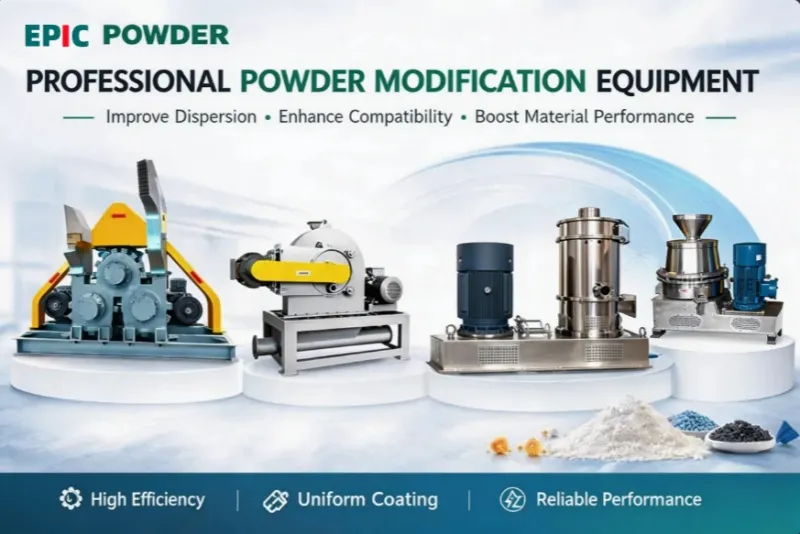
The quartz stone industry primarily uses three modification processes: Dry, Wet, and Combined Dry-Wet. Epic Powder provides targeted industrial equipment solutions for each process:
1. Wet Modification Process
The silane coupling agent is prepared into a uniform solution, mixed thoroughly with quartz powder, heated to react, and then dewatered and dried.
- Characteristics: Extremely uniform coating, exceptional resin compatibility, dense slab structure, and minimal defects. However, it requires multiple process steps and higher energy consumption.
- Applications: Premium solid-color quartz slabs and high-precision home decoration panels.
- Powder Solution: Combined with the Wet Grinding and Coating System, the material achieves molecular-level uniform mixing. Downstream integration with centrifugal dewatering and flash drying significantly reduces overall energy consumption.
2. Dry Modification Process (Mainstream Mass Production)
The coupling agent solution is atomized and sprayed into quartz powder under high-speed agitation and heating. The modified powder is discharged directly after the reaction.
- Characteristics: Simple workflow, no drying stage required, high throughput, and low operational cost.
- Applications: Standard general-purpose quartz slabs and commercial engineering projects.
- Epic Powder Solution — Continuous Surface Modification System: Dry modification often struggles with uneven dispersion, leading to wasted coupling agent. The Epic Continuous Three-Roller-Coating machine solves this with a screw-dosed liquid feeder and a multi-chamber continuous design:
- Precision Atomization: Liquid coupling agents are finely atomized through dual-fluid nozzles and coat the fluidizing quartz powder like mist.
- Three-Stage High-Speed Dispersion: High-speed rotors generate strong shear force to deagglomerate powder clusters, ensuring 360° coverage on individual particles.
- Integrated Temperature Control: Built-in heating jackets keep the reaction at the optimal condensation temperature, reducing coupling agent consumption by 15% to 30%.
| Traditional Dry Modification | Epic Continuous Modification System |
| Batch production with low throughput | Continuous processing (1–10 t/h per line) |
| Liquid dripped directly; prone to agglomeration | Atomized spraying; coating rate >98% |
| Poor thermal efficiency and uneven temperature | Precise thermal control and thorough reaction |
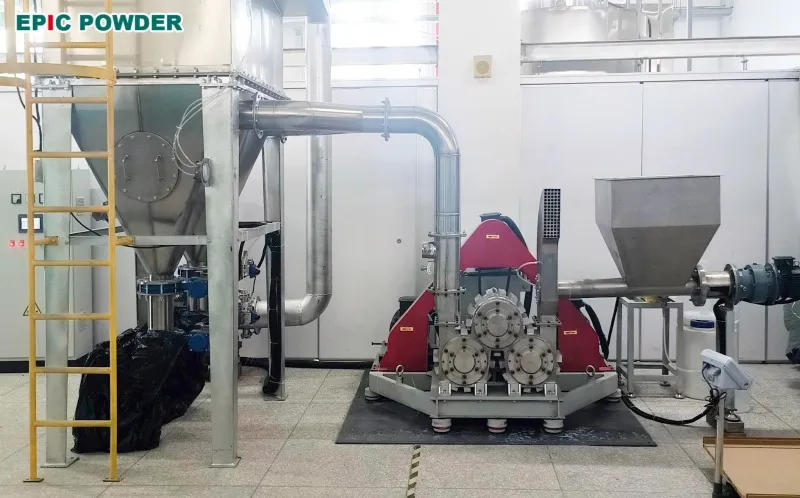
3. Combined Dry-Wet Modification Process
A precise coupling agent solution (8%–10% of total powder mass) is added to the quartz powder. The mixture is ground in a ball mill for 1 hour, dried at a constant 110°C, and then air-classified into finished products.
- Key Controls: Water addition and grinding time must be strictly managed. Too much water causes caking and introduces impurities; too little water causes uneven coating.
- Applications & Advantages: Delivers high powder purity, excellent dispersion, and strong resin bonding. Slabs produced with this powder feature high hardness, stain resistance, and uniform color. It is the preferred process for premium brand quartz slabs.
- Powder Solution — Ball Mill + Air Classifier Modification Line:
- The coupling agent is introduced during the grinding stage in the Ball Mill with Mechanical Liners. The mechanical impact and frictional heat drive mechanochemical surface modification.
- The downstream Air Classifier separates the modified powder into distinct particle size distributions (e.g., 325 mesh, 800 mesh, 1250 mesh) without introducing coarse contaminants into the final product.
Summary:
High-quality quartz powder modification is the core factor determining the strength, stain resistance, and void-free quality of engineered quartz slabs. Advanced, stable modification equipment bridges chemical theory and industrial production. Epic Powder’s continuous modification systems and ultra-fine classification machinery help manufacturers maximize coupling agent efficiency, improve powder coating quality, and produce premium quartz slabs.

“Thanks for reading. I hope my article helps. Please leave a comment down below. You may also contact Zelda online customer representative for any further inquiries.”
— Posted by Emily Chen