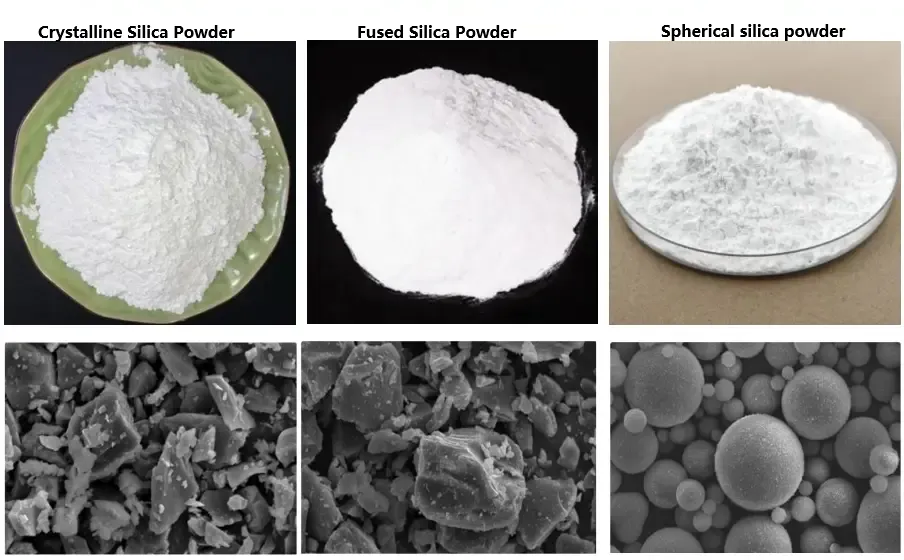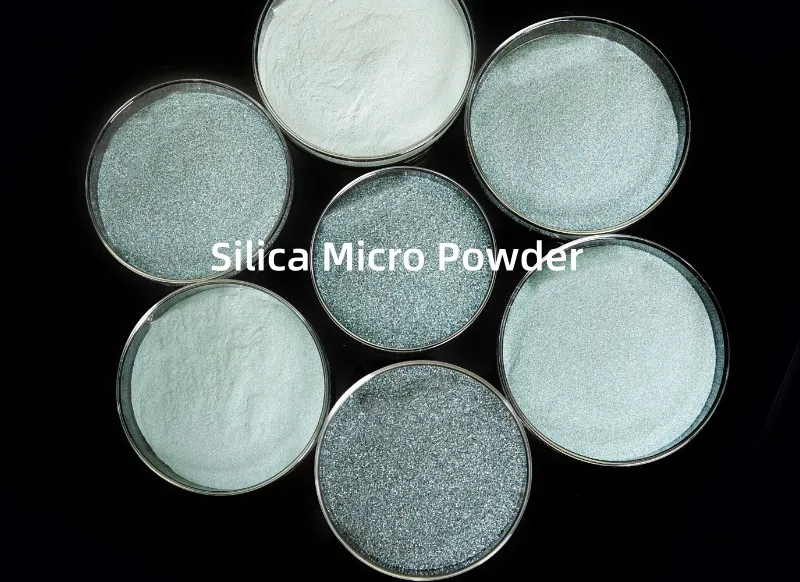
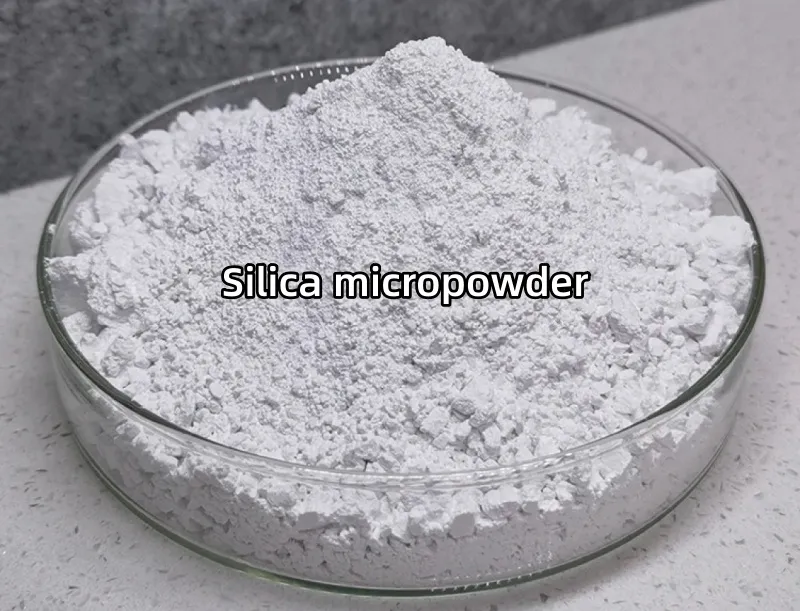
Silicon micropowder is a silicon dioxide (SiO₂) powder material produced from crystalline quartz, fused quartz, and related raw materials through processes such as crushing, grinding, precision classification, and impurity removal.
Classification and Characteristics of Silicon Micropowder
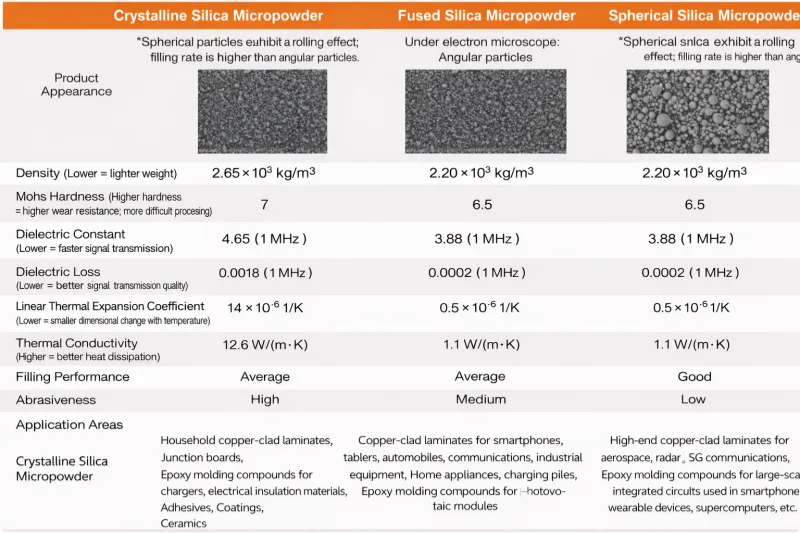
Based on differences in particle morphology and physical structure, silica micropowder is commonly classified into crystalline silica micropowder, fused (amorphous) silica micropowder, and spherical silica micropowder. Their overall performance and market value increase in this order.
Angular Crystalline Silicon Micropowder
Source:
Produced from natural quartz lumps or quartz sand through grinding and impurity removal.
Characteristics:
- Mature processing technology and relatively low cost
- High mechanical strength and hardness
- Relatively large linear thermal expansion coefficient
- Irregular angular particle shape, which can cause increased wear on processing equipment and molds
Angular Fused Silicon Micropowder
Source:
Manufactured from fused quartz or glass materials obtained through high-temperature melting, followed by grinding and classification.
Characteristics:
- Amorphous structure
- Extremely low thermal expansion coefficient (≈ 0.5 × 10⁻⁶ /K)
- Excellent electrical insulation properties
- Superior thermal stability compared with crystalline silica
Spherical Silicon Micropowder
Source:
Produced from selected high-purity angular silica micropowder using flame spheroidization, explosion spheroidization, or liquid-phase methods, where particles are melted and reshaped into spheres by surface tension.
Characteristics:
- Highly regular spherical particle morphology
- Excellent flowability and low internal stress
- High packing density and filling efficiency
- Small specific surface area
- Considered a premium, high-end silica micropowder product
Core Processing Technologies: Grinding and Precision Classification
The quality of silicon micropowder depends not only on the raw materials but also critically on the accuracy of grinding and classification processes.
Grinding Process
Grinding determines the primary particle size and purity of the product. To avoid metal contamination and ensure high purity, high-performance silica micropowder is typically produced using the following technologies:
Ball Mill + Classifier Closed-Circuit System
- Ball mill linings are commonly made of alumina ceramics or silica, and grinding media are high-alumina balls to prevent iron contamination
- By adjusting the ball-to-material ratio and rotational speed, bulk raw materials are ground to the micron scale
Air Jet Mill
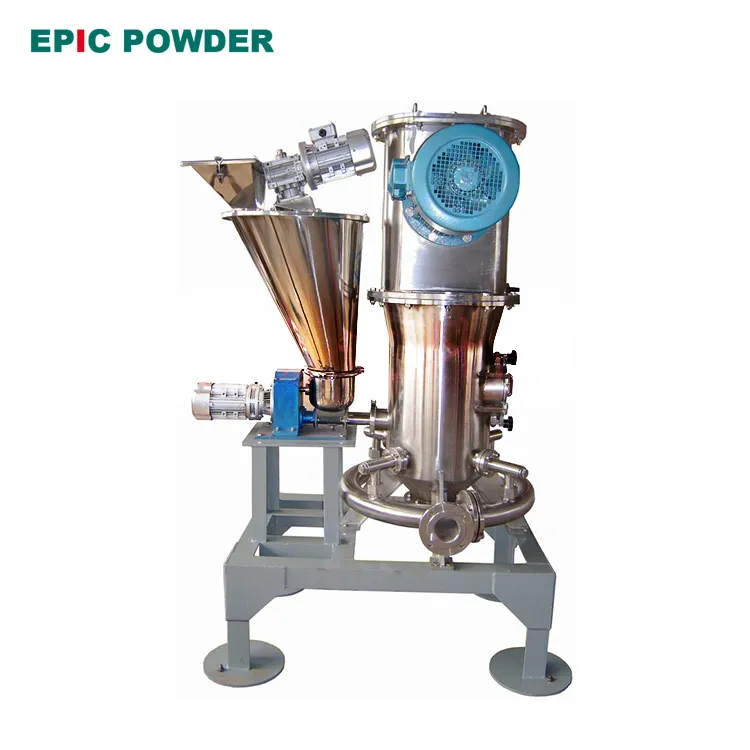
For applications requiring ultra-high purity and ultra-fine particle size, the air jet mill is a key piece of equipment.
Key advantages:
- Media-free autogenous grinding: Particle size reduction is achieved through high-speed inter-particle collision, eliminating contamination from grinding media
- Low-temperature operation: Adiabatic expansion of compressed air at the nozzles produces a cooling effect, effectively counteracting grinding heat and preserving the amorphous structure of fused silica
- Precise particle size control: By adjusting air pressure and feed rate, silica micropowder can be processed to the submicron range (D50 < 2 μm)
2.2 Precision Classification
Classification defines the cut size and the narrowness of the particle size distribution (PSD).
Operating principle:
A balance between centrifugal force generated by a high-speed rotating classifier wheel and the radial drag force created by airflow.
Key benefits:
- Efficient removal of oversized particles (Dmax)
- Precise extraction of fine fractions
- For spherical silica micropowder, precision classification ensures that post-spheroidization particle size distribution meets the stringent requirements of high-performance copper-clad laminates
Application Areas of Silicon Micropowder
Copper-Clad Laminate (CCL) Applications
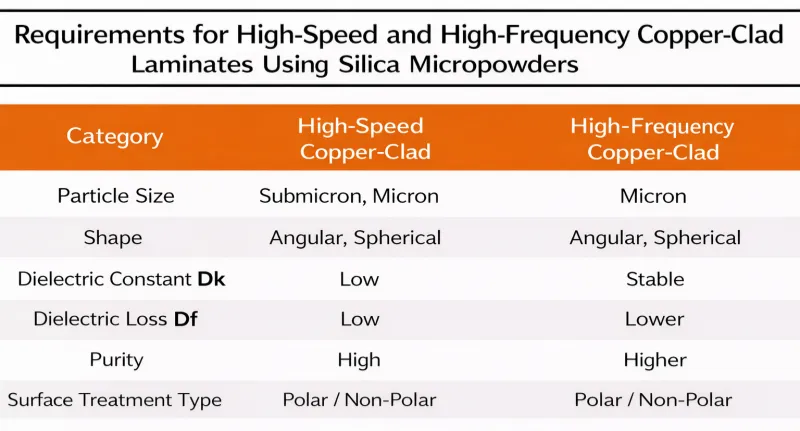
- Standard CCL:
Typically uses angular crystalline silica micropowder, primarily for cost reduction and basic filling functions. - Mid-to-High-End Substrates:
HDI substrates used in smartphones and automotive electronics commonly employ fused silica micropowder to benefit from its low dielectric loss and low thermal expansion. - High-Speed / High-Frequency Substrates (5G, Supercomputing):
Modified spherical silica micropowder is essential. Its high packing efficiency helps reduce thermal expansion, while its ultra-low impurity content and uniform spherical shape significantly reduce signal transmission loss and delay.
Epoxy Molding Compound (EMC) Applications
In semiconductor packaging:
- Mid- and low-end EMC products generally use angular silica micropowder
- High-end EMC formulations rely primarily on spherical silica micropowder
Spherical particles improve compound flowability, reduce shear stress on delicate chips and bonding wires, and significantly decrease wear on dispensing equipment and precision molds, thereby extending equipment service life.
Conclusion: Epic Powder Empowering Precision Silicon Micropowder Production
To meet the extremely stringent requirements for high purity and narrow particle size distribution in silica micropowder production, Epic Powder provides advanced, integrated processing solutions.
Its Ball Mill + Classifier production lines feature full ceramic protection designs to ensure metal-free processing throughout the entire production chain. The core high-precision air classifiers deliver accurate cut points and long-term operational stability.
The MQW series fluidized-bed jet mills, combined with high-efficiency air classifiers and full ceramic lining technology, ensure ultra-high purity during processing. This system can precisely control D100 < 10 μm and achieve stable mass production within a D50 range of 1.0–1.5 μm. With extensive global project experience, Epic Powder continues to support customers in the new energy and semiconductor industries with world-class powder processing equipment.

“Thanks for reading. I hope my article helps. Please leave a comment down below. You may also contact Zelda online customer representative for any further inquiries.”
— Posted by Emily Chen