Ultrafine quartz grinding requires precision, strict contamination control, and highly stable performance. If you work with quartz ultrafine grinding, you already know that consistently reaching D97 ≤ 10 μm while maintaining purity and maximizing yield is challenging. Whether you’re operating in semiconductor manufacturing, photovoltaic materials, or high-end coatings, today’s demand for ultrafine silica powder processing is higher than ever. At the same time, the acceptable margin for error has become extremely small.
This guide breaks down what it truly takes to grind quartz below 10 μm. It explains the strengths and weaknesses of jet mills, fluidized bed mills, and classifier mills. It also reveals why traditional grinding systems often fail. You’ll find real data, practical insights, and key process parameters that are essential for stable, repeatable ultrafine results.
Understanding Ultrafine Quartz Grinding – What Does D10, D50, D97 Mean?
In ultrafine quartz grinding, particle size distribution (PSD) determines product quality. The most important PSD terms include:
- D50: The median particle size. 50% of particles are finer than this value.
- D97: The size below which 97% of particles fall. This shows how fine the main product body is.
- D100: The maximum particle size in the batch.
A clear understanding of these terms helps match powder grades to specific applications.
Typical Quartz PSD Requirements by Industry
| Application | Typical Requirement |
|---|---|
| Semiconductor / CMP | D50 ≤ 2 μm |
| Electronic Glass & Optical | D97 ≤ 5–8 μm |
| High-End Paints / Coatings | D97 ≤ 10–15 μm |
For example, CMP slurries demand extremely fine quartz powder. They typically require a D50 around 2 μm for surface smoothness and defect control. Electronic glass and optical industries accept slightly wider PSD, usually D97 around 5–8 μm, to balance performance with cost. Paints and coatings need ultrafine quartz for better dispersion and gloss, with D97 between 10 and 15 μm.
Why Particle Size and Purity Are Linked?
- Smaller particles increase surface area and improve reactivity or transparency.
- Narrow PSD ensures stable performance—for example, consistent polishing in CMP slurries.
- Purity becomes more difficult to maintain as particles get finer. Some grinding systems introduce contamination.
Ultrafine quartz powder selection is not only about reaching a micron-level number. It also requires achieving a tight particle size distribution aligned with the product’s performance and purity standards.
Why Traditional Grinding Methods Fail Below 10 μm
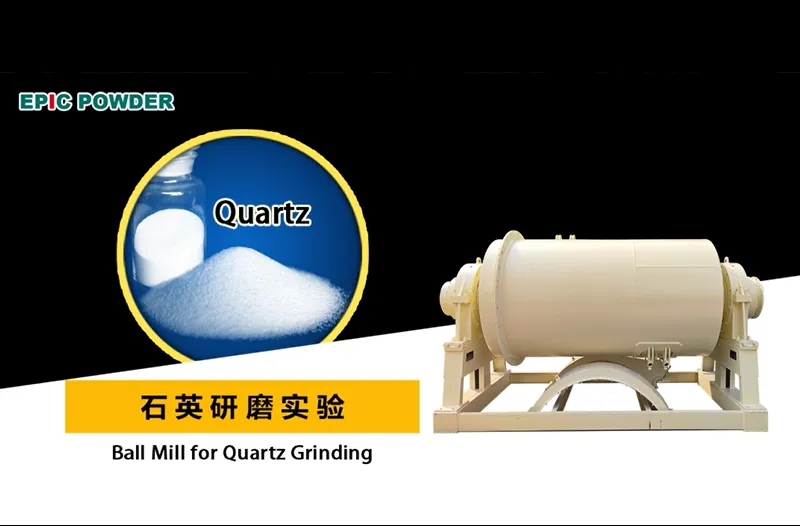
Conventional grinding systems—such as standard ball mills, Raymond mills, and vertical mills—struggle to produce quartz powders finer than 10 μm. They face three major limitations:
Particle Size Limitations:
Mechanical mills do not easily achieve particles below 10 μm. They produce wide PSD results, containing both coarse and fine particles.
Low Ultrafine Yield:
Traditional mills repeatedly grind fine particles but cannot effectively break down harder quartz particles. This leads to low yield of ultrafines.
High Contamination Risk:
Steel grinding media introduce iron (Fe) and chromium (Cr) contamination. These impurities are unacceptable for semiconductor or optical applications.
In short, conventional mills produce inconsistent PSD and higher contamination. They are unsuitable for high-purity quartz powder with D97 < 10 μm.
Proven Technologies for Ultrafine Quartz Grinding
Fluidized Bed Opposed Jet Mill (Most Preferred Choice)
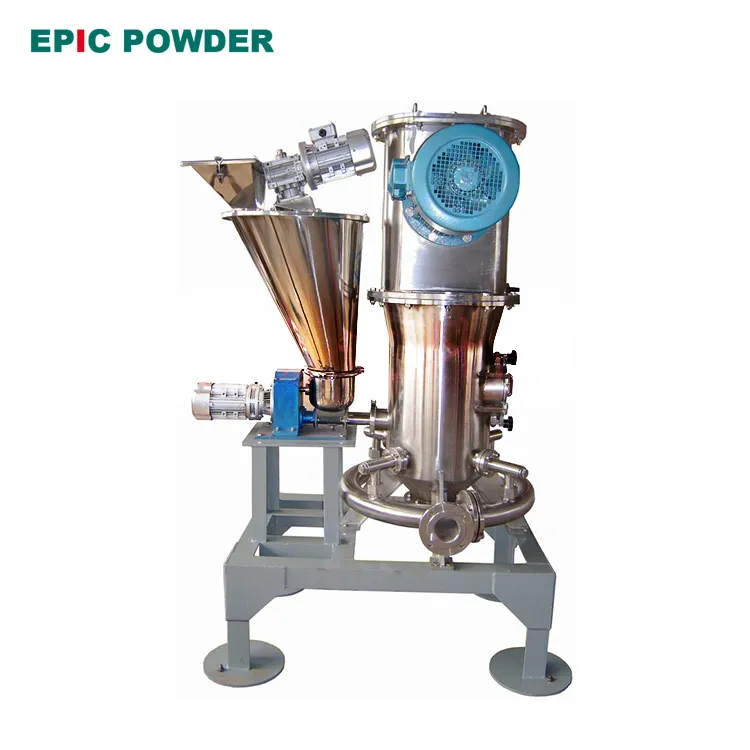
This design uses high-pressure gas jets to accelerate particles and cause high-energy collisions. There is no metal-to-metal contact. Ceramic linings maintain purity. The system commonly achieves D97 of 5–10 μm in one pass, making it ideal for high-purity quartz used in semiconductor and electronic glass applications.
Jet Mill + High-Precision Air Classifier (Closed-Circuit System)
A closed-circuit operation improves PSD control. Coarse particles are continuously returned for further grinding. This setup achieves:
- D97 < 8 μm
- D50 as low as 1.5–2 μm
It is widely used for CMP-grade silica and ultrafine silica powder requiring extremely narrow PSD.
Ceramic Ball Mill + Multi-Stage Classifier (Budget Option)
This is a lower-cost solution. Ceramic media reduce iron contamination, but PSD is broader and production is slower. It is suitable for D97 around 10–15 μm, common in coatings and general-grade silica powders.
Jet Mill vs. Ball Mill + Classifier
| Factor | Jet Mill | Ball Mill + Classifier |
|---|---|---|
| Achievable Size | D97 ≤ 8 μm; D50 1.5–2 μm | D97 10–15 μm; D50 > 3 μm |
| Purity (Fe contamination) | <10 ppm | >50 ppm |
| Capacity | 0.5–5 t/h | Higher throughput |
| Energy Consumption | 40–60 kWh/t | 80–120 kWh/t |
| Costs | Higher initial investment | Lower upfront cost |
| Maintenance | Low wear | Frequent media/liner replacement |
Critical Process Parameters for Ultrafine Quartz Grinding
| Parameter | Importance | Notes |
|---|---|---|
| Feed Size & Moisture | Prevents clogging | Feed <150 μm; moisture <1% |
| Classifier Speed & Airflow | Controls PSD | Higher speed → finer D97 |
| Grinding Pressure | Affects fineness | Jet mills use 4–8 bar |
| Temperature Control | Prevents quartz phase change | Keep <573°C |
Key points:
- Too large or wet feed reduces efficiency.
- Classifier tuning is crucial for narrow PSD.
- High pressure increases grinding intensity.
- Good thermal management keeps quartz stable.
Real-World Epic Powder Cases
Case 1 – China: Photovoltaic Quartz Crucible Manufacturer:
Requirement: D97 ≈ 8.3 μm, 2 t/h
Solution: Fluidized bed jet mill
Result: Stable ultrafine size, minimal contamination.
Case 2 – Europe: Semiconductor-Grade Silica:
Requirement: D50 ≈ 1.8 μm, Fe < 10 ppm
Solution: Jet mill + high-precision classifier
Result: CMP-grade purity and PSD.
Case 3 – India: High-End Coatings Manufacturer:
Requirement: D97 ≈ 9.5 μm
Result: 30% increase in ultrafine yield using closed-circuit jet mill.
How to Choose the Right Ultrafine Quartz Grinding System?
Ask the following questions:
- What PSD do you need?
- What is your purity requirement?
- What capacity do you need?
- What is your budget?
- How narrow must your PSD be?
- Is metal contamination acceptable?
- What energy efficiency do you want?
- How much downtime can you tolerate?
- How much space is available?
- Will you expand later?
Why Jet Mill + Classifier Systems Win in 2025?
- Consistent ultrafine results (D97 ≤ 8 μm).
- Minimal contamination due to ceramic liners.
- Lower energy consumption.
- Reduced maintenance.
- Easy to scale from pilot to mass production.
How to Keep Iron Contamination Below 10 ppm?
- Use ceramic or alumina-lined chambers.
- Avoid steel media entirely.
- Use jet mills for metal-free grinding.
- Regularly maintain equipment.
- Use precision classifiers to reject contaminated particles.
If you need support in designing or optimizing an ultrafine quartz grinding system, feel free to ask!

“Thanks for reading. I hope my article helps. Please leave a comment down below. You may also contact Zelda online customer representative for any further inquiries.”
— Posted by Emily Chen