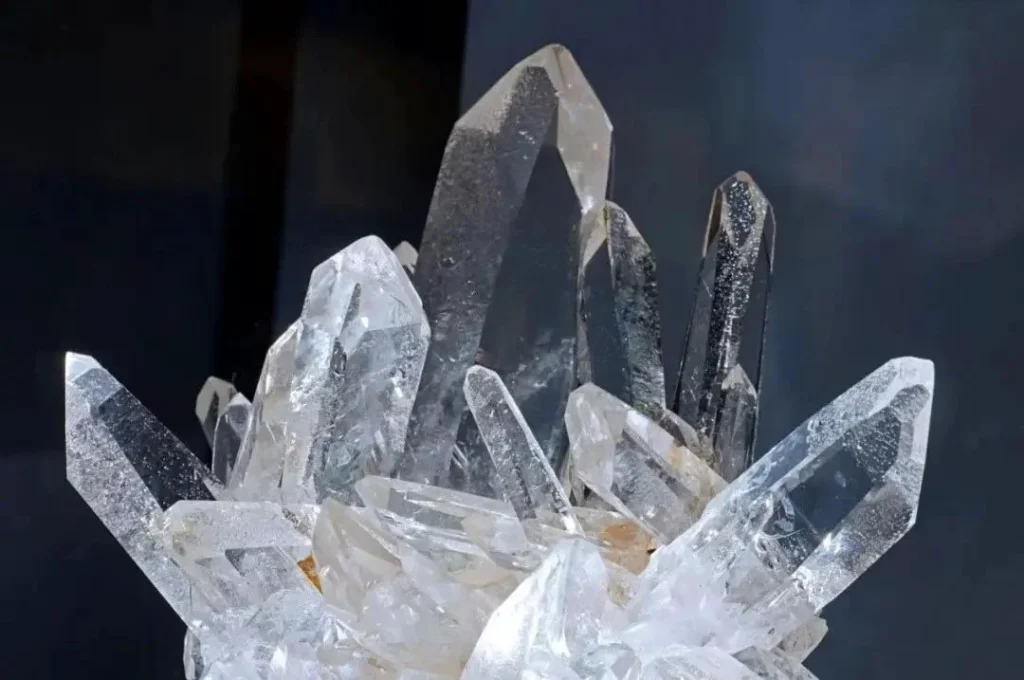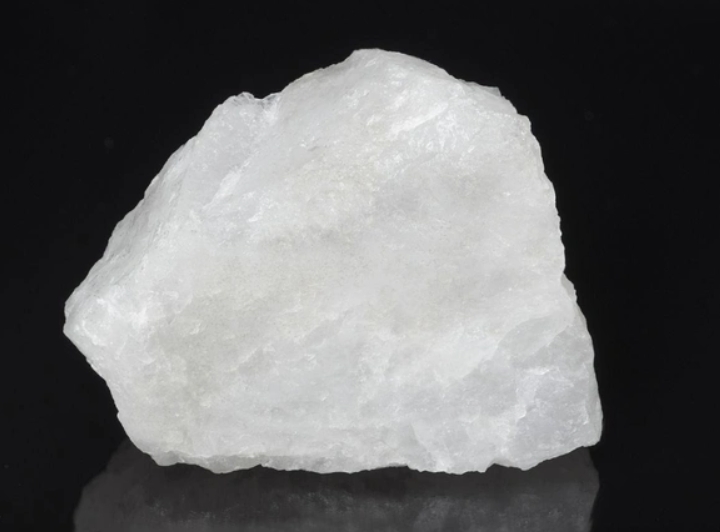
As AI computing infrastructure expands, high-frequency, high-speed copper clad laminates (CCL) have become a focal point of the electronics supply chain. As the core inorganic filler in CCL and epoxy molding compounds (EMC), silica powder has moved from an “ordinary filler” to a critical component governing signal loss, thermal expansion and dimensional stability. Industry data shows China’s silica powder demand reached roughly 418,000 tonnes in 2024 and 473,000 tonnes in 2025, up 13.2% year on year, with high-speed CCL growing even faster. Yet powders sold under the same name behave very differently in high-end electronic applications — and the root cause is rarely the downstream formulation. It is the grinding and classification process upstream.
This article examines grinding equipment as the starting point: the process logic connecting jet mills, continuous ball mill classification lines, precision classifiers, spheroidization and surface modification, plus practical selection guidance for different CCL grades. For a wider view of the journey from raw material to high-end applications, see our comprehensive analysis of silica micropowder.
AI Computing Puts Silica Powder at the Performance Switch
A copper clad laminate is made by impregnating reinforcement such as glass fiber cloth with resin, then laminating one or both sides with copper foil under heat and pressure. Inorganic filler occupies a large volume fraction of the substrate. Its core job is to lower the resin’s coefficient of thermal expansion (CTE) so it matches the copper foil, preventing delamination or warpage when heated. Compared with talc or aluminum hydroxide, silica powder offers a lower dielectric constant and better thermal stability, making it the preferred filler for high-frequency, high-speed transmission. Our overview of silica micropowder in the chip industry explains this role in more detail.
In epoxy molding compounds, silica powder can account for 60%–90% by mass, lowering CTE and improving insulation, thermal conductivity and mechanical strength to suit advanced packaging. Meanwhile, high-layer-count PCBs for AI servers are driving CCL toward M7, M8, M9 and even M10 grades, with far stricter demands on signal loss (Dk/Df), warpage resistance and dimensional stability. Powders must now meet a combined specification: high purity, high sphericity, narrow particle size distribution, low dielectric loss and surface modification.
In terms of morphology, ordinary angular silica powder has clear limits on loading capacity. Spherical silica powder, with its rounded particles, offers excellent flowability and high packing fraction — above 92% in some cases — reducing resin consumption and mold wear. It is therefore the filler of choice for high-frequency CCL and semiconductor packaging. The characteristics and applications of three common silica powder types are compared here. This shift from “filler” to “critical component” is exactly what has pushed upstream grinding precision into the spotlight.
Grinding Equipment: The First Definition of Powder Performance
A typical silica powder production chain runs: raw ore selection → calcination and water quenching → ultrafine grinding and classification → multi-stage purification → spheroidization → surface modification. Ultrafine grinding is not simply about making particles smaller. It simultaneously determines particle size distribution, morphology, surface activity and impurity pickup — setting the baseline for every downstream step.
Calcination and water quenching generate micro-cracks inside quartz particles, opening fluid inclusions and exposing sealed impurities to create mass-transfer channels for leaching. Grinding then achieves mineral liberation and removes coarse particles that could create reliability risks in electronic packaging. To understand where comminution fits in high-purity quartz production, read the key role of ultrafine pulverization equipment. The full transformation from quartz ore to high-purity quartz is covered separately.
Jet Mills: A Media-Free Route to High-Purity Silica Powder
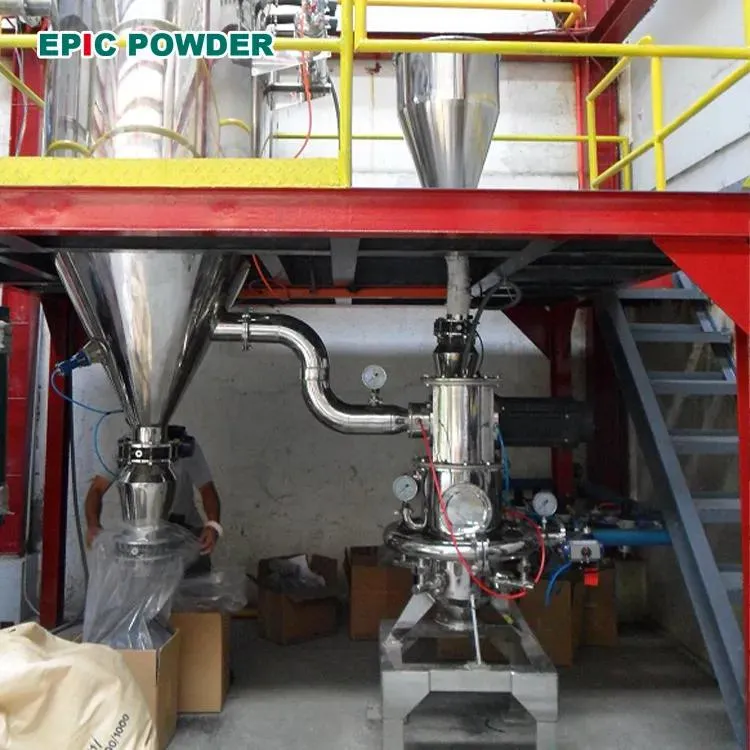
A jet mill — typically a fluidized-bed opposed-jet design — works like this: filtered, dried compressed air is injected at high speed through Laval nozzles into the grinding chamber. Where multiple high-pressure air streams intersect, particles repeatedly collide, rub and shear against each other, achieving particle-on-particle self-breakage. The ground material rises with the airflow into the classification zone, where a high-speed rotating classifier wheel generates strong centrifugal force. Coarse particles return to the grinding zone; fine particles pass the wheel and are collected in a cyclone separator and dust collector.
This mechanism delivers three direct benefits. First, virtually no grinding media contact: with ceramic linings such as alumina or silicon carbide, iron and aluminum contamination can be kept extremely low, meeting the electrical requirements of integrated circuits. Second, low-temperature grinding: heat-sensitive materials avoid phase transformation. Third, a narrow particle size distribution: the built-in classifier removes coarse particles in real time, with D97 typically controlled in the 3–45 μm range and a stable D50 of about 1–5 μm, preventing filler sedimentation in resin.
In a typical MQW horizontal fluidized-bed opposed jet mill, feed size is generally below 1–3 mm, capacity spans lab scale to full production, and air pressure runs at 0.6–1 MPa. For specifications and working principles, visit our jet mill equipment page. Our article on jet mills driving breakthroughs in silica micropowder technology goes further.
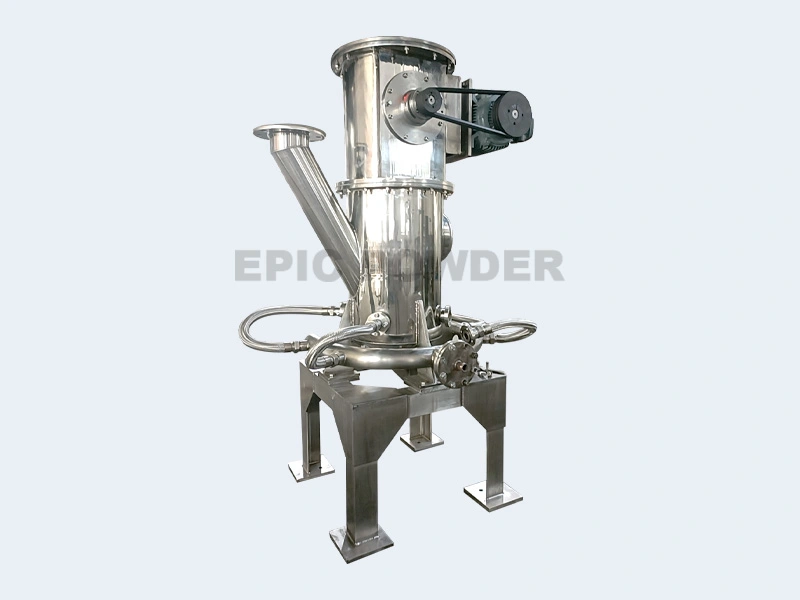
Continuous Ball Mill with Classifier: The Workhorse for Angular Powder
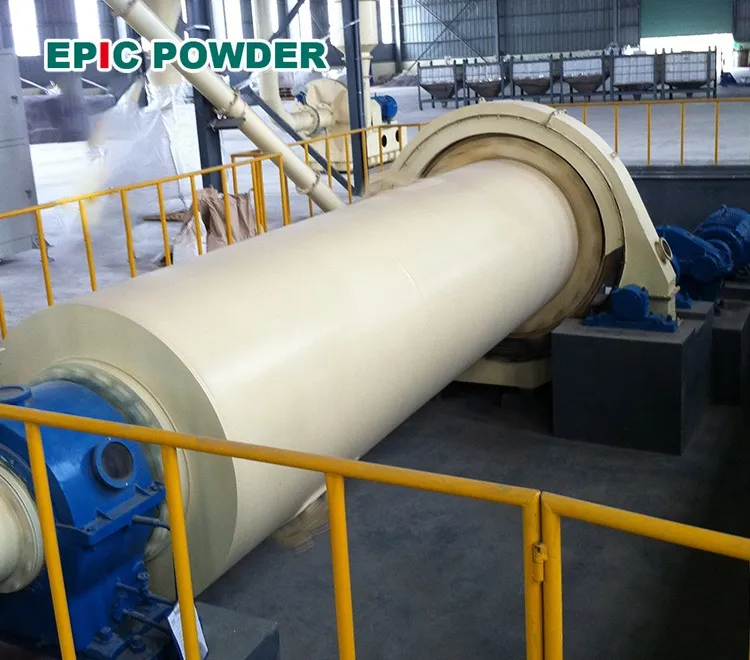
A ball mill relies on mechanical impact plus friction and shear: grinding media moves at high speed inside the cylinder, repeatedly striking, rolling and crushing the quartz feed. Its advantages are straightforward — a mature process, low capital investment and high single-machine throughput, which significantly reduces cost per tonne. Combined with a multi-stage air classifier, a ball mill system can run continuously and stably, making it the mainstream choice for mid-to-low-end CCL and general-purpose fillers.
The limitations are equally clear. The crushing action is relatively aggressive, so particles are mostly irregular and angular. Size control depends on grinding time and classification accuracy, with limited ultrafine capability, a broader distribution and modest batch-to-batch consistency. More importantly, wear of the grinding media and lining introduces iron and aluminum, which can affect powder whiteness and electrical performance. See our ball mill equipment page and our guide to eliminating iron contamination in fine quartz grinding.
If a ball mill route must produce higher-grade powder, three measures are recommended: use alumina or silica linings to reduce metal contamination; optimize media grading and filling ratio to limit over-grinding; and add multi-stage classification to extract qualified fines promptly. The effect of lining choice on whiteness is discussed in this analysis of grinding liners. For classification accuracy, see precise classification of ultrafine quartz powder and advanced air classification for narrow distributions.
Jet Mill vs Ball Mill: A Selection Boundary at a Glance
| Dimension | Jet Mill (fluidized-bed opposed) | Ball Mill + Classification Line |
|---|---|---|
| Grinding principle | High-speed air acceleration; particle-on-particle impact, no media | Media impact and friction/shear, forced crushing |
| Typical size | D50 about 1–5 μm; D97 controllable at 3–45 μm | Micron range achievable; ultrafine end limited by media and time |
| Size distribution | Narrow; classifier removes coarse particles in real time | Broader; relies on multi-stage classification and grinding time |
| Particle morphology | Rounded edges, relatively smooth surface | Irregular, angular particles |
| Contamination | Shortest introduction path; low Fe/Al with ceramic linings | Media and lining wear is the main contamination source |
| Output and cost | Higher energy and capital cost per tonne | High output, low investment, clear cost-per-tonne advantage |
| Best-fit applications | Electronic grade, high-speed CCL, EMC, spherical powder precursor | Mid/low-end CCL, general filler, coatings and refractories |
For a CCL-specific comparison, read jet milling vs ball milling for CCL silicon micropowder and how ultrafine grinding reshapes silica powder performance limits for CCL.
From Grinding to Spheroidization: Precursor Powder Sets the Ceiling
Spheroidization is the high-end form of silica powder. Physical routes include flame fusion, direct-combustion/VMC, plasma and high-temperature calcination; chemical routes include vapor-phase synthesis, sol-gel, hydrothermal synthesis and precipitation. Today, the mainstream mass-production paths are flame-fused spherical silica, direct-combustion/VMC spherical silica and chemically synthesized spherical silica.
Whichever route is chosen, the precursor powder produced by upstream grinding sets the performance ceiling. Flame spheroidization requires quartz to be ground into a fine, uniform powder. If precursor particles are too large, they melt incompletely in the flame and form “pseudo-spheres”; if the size distribution is too wide, final sphericity becomes inconsistent; if impurity levels are high, melting introduces defects and raises dielectric loss. In other words, spheroidization is not a standalone step that turns any powder into a premium product — it amplifies and reveals the quality created by grinding and classification.
High-end spherical silica production must therefore design ultrafine grinding, precision classification, deep purification, spheroidization and surface modification as one integrated system. Control points for each stage are covered in how to control each step in spherical silicon micropowder production. Process details for preparing high-sphericity powder from quartz are in how to prepare high-sphericity silica micropowder.
Surface Modification: Making Powder Truly Compatible with Resin
Silane coupling agents improve interfacial compatibility between powder and resin, suppress agglomeration, and enhance the mechanical and thermal properties of composites. Research shows that particle size and surface modification state directly affect epoxy resin composite performance; modified spherical silica consistently outperforms unmodified powder.
The more valuable engineering approach is “grinding–modification integration”: injecting silane coupling agent during jet milling or stirred milling, when particles have just generated fresh fracture surfaces and active sites. At that moment the coupling agent bonds more strongly to the powder surface. Modified powder also becomes more hydrophobic, helping prevent external moisture from penetrating the CCL substrate and preserving signal stability under high temperature and humidity. For the reasoning behind this treatment, see why silica micropowder needs surface modification. Equipment and process details are on our surface modification page and in quartz powder surface modification technology.
Work Backwards from the End Application
Equipment selection should start from the end specification, not from the machine:
- M9/M10 high-speed CCL and advanced packaging: jet milling + precision air classification + spheroidization + surface modification, with tight control of purity, sphericity, narrow distribution and low dielectric loss.
- M7/M8 CCL and mainstream EMC: a jet mill route protects distribution and purity; where cost matters, use a ball mill with multi-stage classification plus stronger linings and iron removal.
- General filler, coatings, adhesives and refractories: ball mills or mechanical impact mills are sufficient, with output and cost per tonne as the priority.
- Precursor for spherical powder: jet milling is required to produce fine, uniform, agglomerate-free powder and avoid pseudo-spheres during spheroidization.
For matching mill types to industrial applications, see how to choose the right quartz grinding mill. If you already know your target fineness, ideal quartz powder fineness by industry and the machine to achieve it helps narrow the choice quickly.
Frequently Asked Questions
Q1: Why must silica powder for CCL be ultrafine ground?
A: CCL fillers must lower resin CTE to match copper foil while keeping dielectric loss low. Only micron-scale grinding with controlled size distribution delivers high loading, low viscosity and stable dispersion in resin, reducing signal loss and warpage risk.
Q2: Which is better for high-purity silica powder — jet mill or ball mill?
A: Jet mills use particle-on-particle impact with no grinding media, introducing almost no iron or aluminum and producing a narrow distribution — ideal for electronic grade and high-end CCL powder. Ball mills offer high output and low cost for angular powder, but need alumina linings and multi-stage classification to control contamination and distribution.
Q3: What are the precursor requirements for spherical silica powder?
A: Fine particle size, narrow distribution, high purity and no hard agglomerates. Oversized particles melt incompletely and form pseudo-spheres; a wide distribution causes inconsistent sphericity. Upstream grinding and classification directly determine the spheroidization ceiling.
Q4: Why is surface modification integrated with grinding?
A: Grinding generates fresh fracture surfaces and active sites. Injecting silane coupling agent at this stage enables in-situ modification with stronger bonding, suppressing agglomeration and improving hydrophobicity and interface compatibility.
Q5: What grinding route suits M9/M10 high-speed CCL?
A: A combined route of jet milling, precision air classification, spheroidization and surface modification is recommended, with tight control of purity, sphericity, narrow particle size distribution and low dielectric loss. Ordinary angular powder cannot meet these demands.
Conclusion
Every performance leap in AI hardware raises the bar for upstream powders. Turning quartz ore into a high-performance filler is essentially a precision engineering exercise in size control and morphology design. Jet mills protect purity and distribution through media-free grinding; continuous ball mill classification lines support the general market with scale and cost advantages; spheroidization and surface modification complete the value upgrade on that foundation. Understanding this chain is how you choose the right equipment and build the right product as CCL technology advances. To discuss a process route for your material and capacity targets, contact us.

Jason Wang, Engineer
Connect with Jason on LinkedIn →
Thank you for reading. I hope my writing is helpful. Leave a comment below. Contact EPIC Powder Online Customer Service Agent for Powder. If you have any further questions, please get in touch.